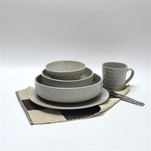
Choosing healthy ceramic tableware requires consideration from the following aspects: 12
Check labels and certifications: Select ceramic tableware with clear labels and certifications to ensure that the product meets national safety standards. High quality ceramic tableware usually comes with labels indicating the manufacturer's information, material specifications, and usage precautions. In addition, choosing products that have passed national quality certification, such as ISO9001 quality management system certification, ensures greater safety.
Observation of appearance: The surface of high-quality ceramic tableware should be smooth and flat, without obvious defects such as cracks, bubbles, black spots, etc. The glaze surface should be uniform, smooth, and free from obvious color differences and delamination. You can gently touch the surface of the tableware with your hand to feel its smoothness and texture.
Tap to listen: Gently tap the edges of ceramic tableware, high-quality tableware will produce a crisp and pleasant sound. If the sound is dull or there is noise, there may be cracks or quality issues.
Smell the odor: High quality ceramic tableware should be odorless. If you smell obvious chemical or other odors, there may be harmful substances present and it is not recommended to purchase.
Choose underglaze color: Ceramic tableware with underglaze color has higher safety, and it is recommended to choose it first. Although the color of underglaze color is not as bright as overglaze color, its safety is more guaranteed and suitable for daily use.
Avoid purchasing tableware with overly bright colors: In order to make the colors bright, manufacturers will add some heavy metal additives to the glaze. Therefore, the brighter the color of the tableware, the more likely it is to exceed the limit of heavy metals.
Choose a legitimate market: When purchasing ceramic tableware, be sure to choose a legitimate market and avoid buying inferior products without a formal manufacturer at a low price. According to national regulations, ceramic tableware should be soaked in 4% acetic acid, and the leaching amount of lead should not exceed 7 milligrams per liter, and the leaching amount of cadmium should not exceed 0.5 milligrams per liter. Most products from legitimate manufacturers can meet this requirement.
Pay attention to the condition of the tableware: touch the surface of the tableware with your hand to see if the inner wall is smooth; Smell with your nose for any unusual odor.