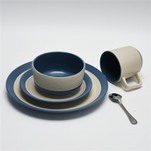
Selecting suitable 3D ceramic tableware starts with grasping two foundational principles: safety and 3D-specific practicality. These two dimensions lay the groundwork for a reliable purchase.
1. Safety First: Verify the "Food-Contact Bottom Line"
3D ceramic tableware often features layered glazes and intricate reliefs, making safety verification more critical than with plain ceramic. Focus on two key checkpoints:
1.1 Material: Prioritize High-Temperature Ceramics
The firing temperature directly determines the material's stability and toxin-leaching risk. Always opt for high-temperature ceramics (fired at ≥1200°C) and avoid low-temperature alternatives.
| Material Type | Key Traits | Safety & Durability | Best For |
|---|---|---|---|
| Stoneware | Dense, hard, impact-resistant, thick glaze | ★★★★★ | Families with kids/elders (daily use) |
| High-White Porcelain | Fine texture, impurity-free, moderate translucency | ★★★★★ | Daily meals + casual entertaining |
| Bone China | Lightweight, translucent (contains bone ash) | ★★★★☆ | Gifting/elegant dining (handle gently) |
| Low-Temperature Ceramics | Porous, thin glaze, brittle | ★☆☆☆☆ | Avoid entirely (risk of lead/cadmium leaching) |
1.2 Glaze: Insist on Lead-Free & Cadmium-Free
3D patterns rely heavily on glazes-poor-quality glazes pose hidden risks:
Ask for certifications: Request a food safety test report (confirm compliance with standards like China's GB 4806.4-2016 or EU's EU 10/2011 for lead/cadmium limits).
Choose the right decoration type: "Underglaze 3D patterns" (patterns sealed under glaze) are safest, as they never touch food. If choosing "overglaze patterns", ensure the glaze feels smooth (not sticky) and doesn't fade when wiped.
Avoid inner-wall clutter: Steer clear of bowls/plates with dense 3D reliefs on the inner surface-oil and detergent easily accumulate in crevices.
2. 3D-Specific Practicality: Balance Aesthetics with Usability
The allure of 3D ceramic lies in its three-dimensional design, but practicality should never be sacrificed for looks.
2.1 Pattern Design: Prioritize Cleanliness & Comfort
Depth matters: Opt for shallow relief (protrusion ≤2mm) or simple geometric 3D patterns. Deeply hollowed, layered patterns (e.g., tangled floral motifs) trap grime and are hard to sanitize.
Edge check: Run your finger along 3D pattern edges-they must be smooth and burr-free to avoid scratching lips or hands.
Function: For rice/soup bowls, avoid protruding rim patterns (prone to spilling); for plates, keep 3D details on the edge (not the food-bearing center).
2.2 Weight & Grip: Choose "Easy to Hold" Over "Heavy Duty"
3D shapes can add unnecessary weight:
For daily use: Select pieces weighing 150–200g (e.g., a rice bowl) with a contour that fits your palm-heavy tableware causes fatigue during meals.
For decoration/entertaining: Slightly heavier pieces (e.g., embossed platters) are acceptable, but ensure the base is flat to prevent wobbling.